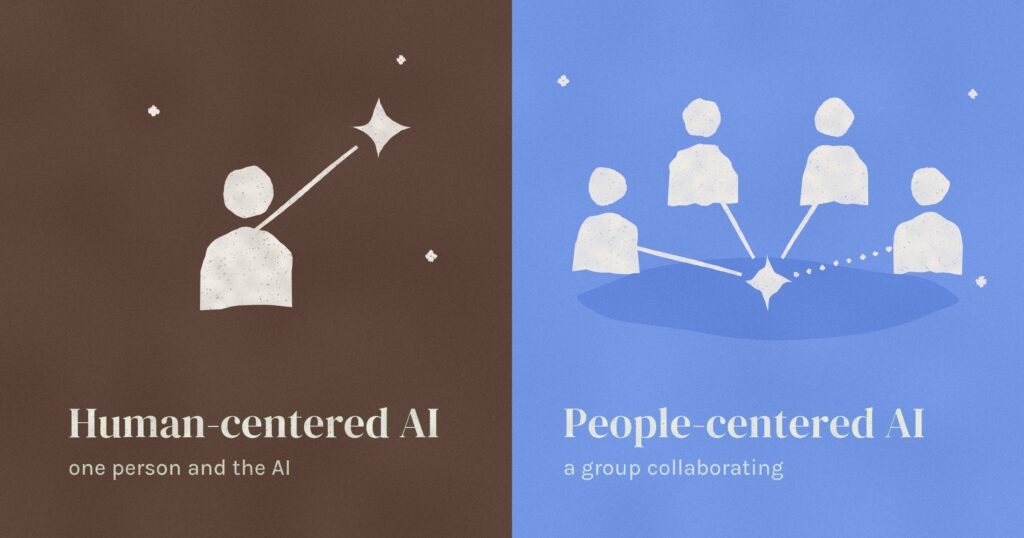
When I studied for my master’s degree in Human-Centered AI (HCAI) at the University of Gothenburg, we learned that HCAI was made popular largely by Ben Shneiderman’s book as a framework and approach for designing and developing AI that serves human interests and augments rather than automates human abilities. The term has come to mean placing individuals at the center, similarly to a user-centered design approach.
People-centered AI, on the other hand, is about groups of people or collaborative efforts. Instead of focusing on one human (Human-centeredness), we focus on people (People-centeredness).
I learned this distinction in the opening keynote by Dr. Yvonne Rogers at NordiCHI ’26, in Vaasa, Finland. In the description of Roger’s talk, People-Centered AI is described as the need to understand “how to support teams and organisations in their workflows and complex tasks, for example, collaborative decision-making”. I think this is a very interesting distinction and a new focus area.
For example, my PhD project is about how students use AI in design education. In my preliminary data collection, I’ve already noticed that students seem to use AI differently when they’re working together with others, compared to when they’re working alone. Some groups might explicitly discuss whether they should use AI or not, and how. Other times, an individual student uses AI without the other group members’ knowledge.
This raises new questions about how, why, and when students decide to use AI in collaborative settings. It also raises questions about transparency and ethics. Transparency might not only be relevant between students and educators but also among students during collaborative work.
We design educators have already pushed students to disclose their AI use to us, teachers, but what if that’s not enough? I’m seeing that there may be a need for students to acknowledge each other’s AI use in collaborative settings as well, which might be a question for people-centered AI research.
Let’s see if I can discover something new about how design students use AI in collaborative settings, and if this could be a contribution for people-centered AI research.